Dear Sir or Madam,
This letter is addressed to all those who, at some point in their professional lives, have worked at the Institut (formerly Service) de Physique Théorique.
As most of you know, the Institute celebrated its sixtieth anniversary last year. This event brought many of you together. It was an opportunity to measure your attachment to us.
At the same time, our Institute, and theoretical physics in general, is facing many new challenges. Many people today doubt science, not only its usefulness, but also its methods and results. The Covid crisis marked a new stage in this attitude of mistrust, and the research carried out at the Institute is no exception. What's more, funding methods have changed radically, and funds are increasingly allocated on a project basis, focused on priorities that are often far removed from the needs of fundamental research.
Motivated by the success of the sixty-year anniversary, but also keen to meet these new challenges, the Institute's management wanted to give its members, past and present, the opportunity to maintain close links over the long term and to invest in the future of the IPhT. It entrusted four of its members with the task of setting up an association. They were tasked with drafting the articles of association and setting up the provisional board for the start-up phase.
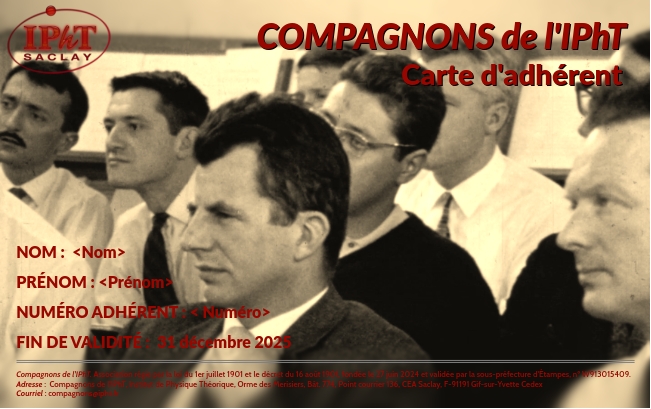
The founding meeting of the "Compagnons of the IPhT" association took place on June 27, 2024. Its aims include, of course, animating the IPhT community, but also promoting the Institute's influence in society. Our initial objectives are modest, and we're counting on you to help us achieve them. It will be up to those of you - and we hope there will be many of you - who decide to become "Compagnons" to build a project, in its animation and outreach components, and to define the scope of its ambitions.
In order to give the Association the means to start its activities, the annual membership fee (from which doctoral students are exempt) has been set at €25 (see registration details and bank account details attached to this e-mail).
For the set-up phase, we've created the compagnons@ipht.fr address, which will enable you to let the provisional office know of your interest in this initiative, your expectations, your availability, and what type of action you could contribute. We also plan to hold a first general meeting of registrants at the IPhT in early 2025.
Please accept, Madam, Sir, the expression of our hope that you will join us.
The board of the association:
Michel Bauer, President ;
Grégoire Misguich, Vice-President ;
Anne Capdepon, Treasurer;
Riccardo Guida, Secretary.
------
Compagnons de l'IPhT. Association régie par la loi du 1er juillet 1901 et le décret du 16 août 1901 fondée le 27 juin 2024 et validée par la sous-préfecture d'Étampes, nº W913015409.
Address : Compagnons de l'IPhT, Institut de Physique Théorique, Orme des Merisiers, Bât. 774, Point courrier 136, CEA Saclay, F-91191 Gif-sur-Yvette Cedex
E-mail : compagnons@ipht.fr
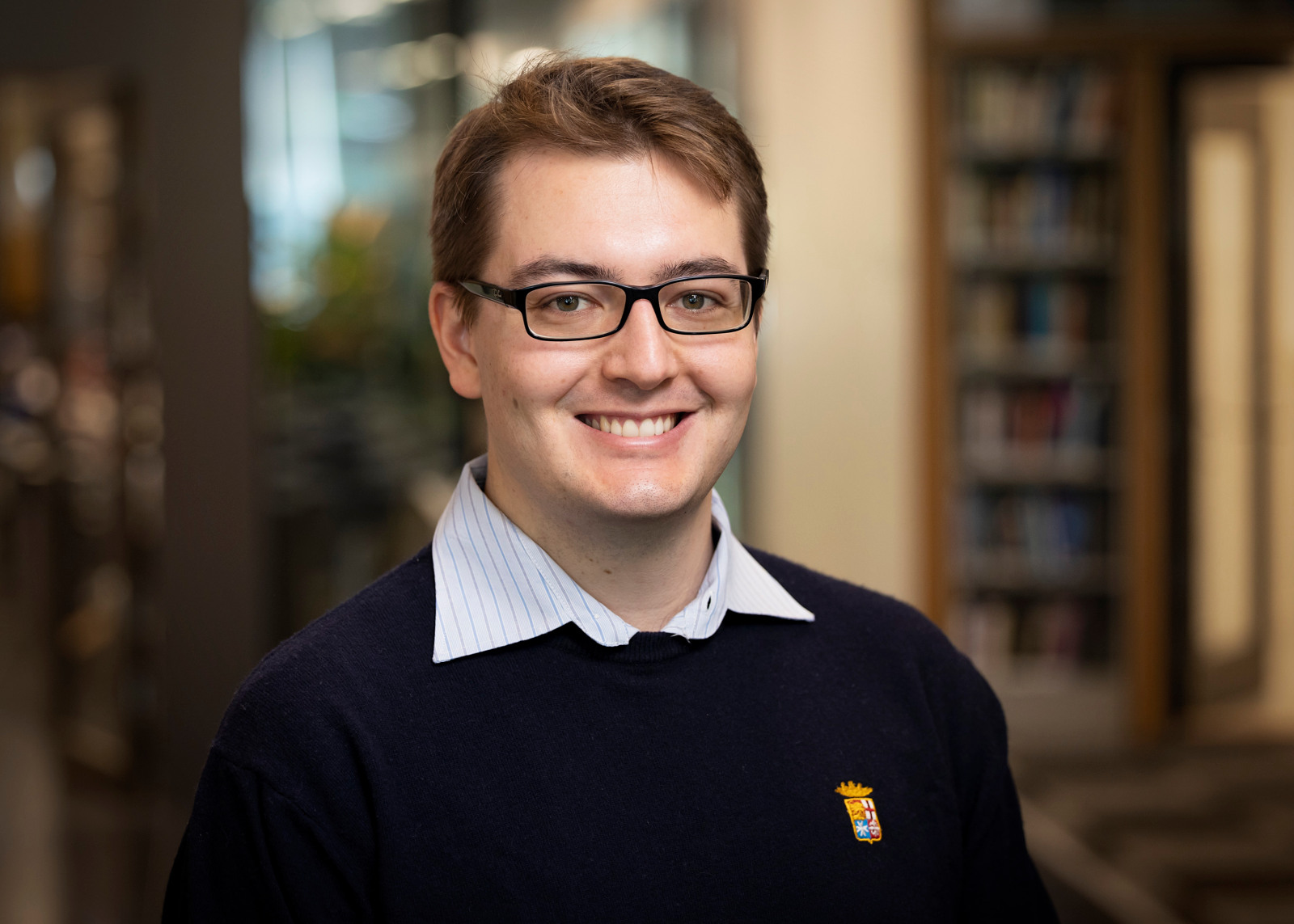
Carlo Heissenberg graduated with flying colors in 2019 from the Scuola Normale Superiore di Pisa, the Italian twin sister of the Ecole Normale de Paris. His initial research focused on the infrared properties of gravitational theories and higher spin theories from the perspective of asymptotic symmetries, a topic that later found phenomenological applications in the context of gravitational wave studies.
It was during his first postdoctoral period at Nordita-Uppsala (2019-2023) that Carlo started working on gravitational wave physics using ideas borrowed from particle physics, such as scattering amplitudes and eikonal exponentiation in particular. He quickly became a leader in the field, publishing several important papers with world-famous physicists such as Gabriele Veneziano. Carlo's group achieved, for instance, the first complete calculation of the gravitational deflection angle to the third post-Minkowskian order in the Newton coupling constant expansion, while simultaneously resolving the high-energy limit problem that was puzzling the community.
In the meantime, Carlo was granted a Marie-Curie fellowship and moved to his second postdoc at Queen Mary, while continuing to work on gravitational wave physics, focusing on new observables (waveforms, angular momentum loss, effect of spins…) that could be calculated efficiently using scattering amplitudes techniques.
Carlo accepted an offer from the IPhT and joined the lab as a permanent member the 4th of November 2024.
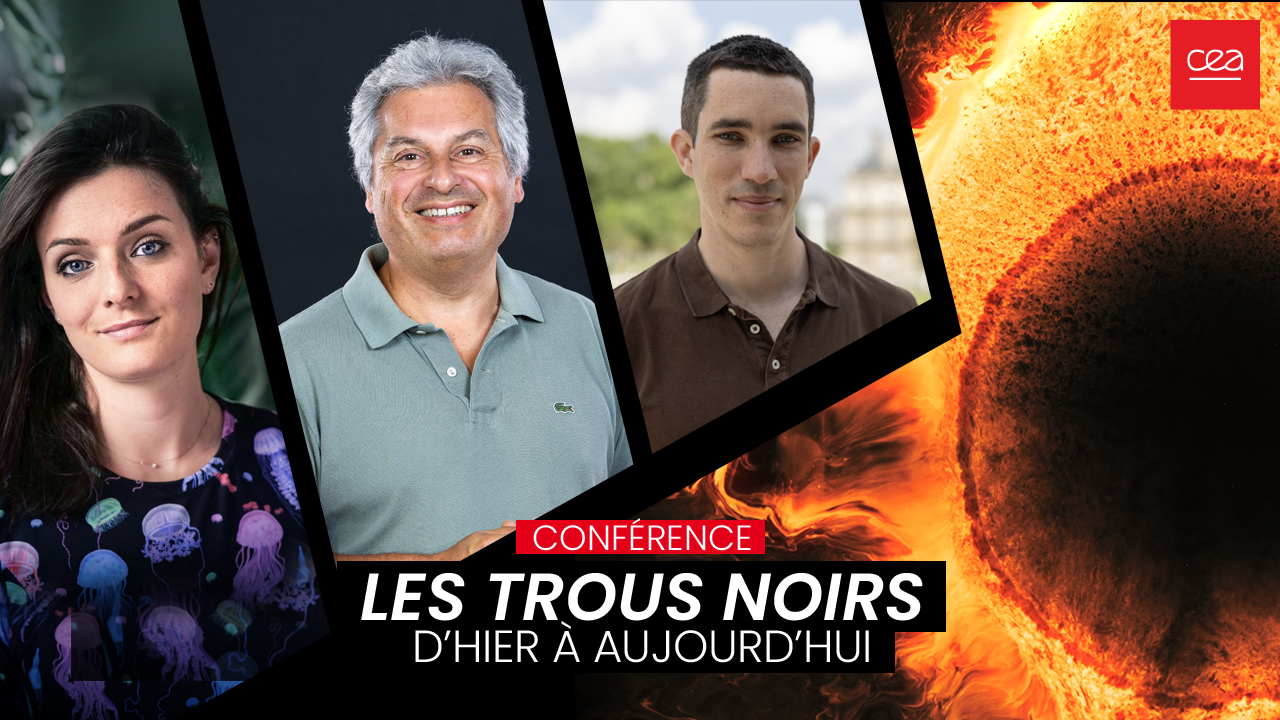
Antoine Bourget, from the IPhT, will soon be appearing on YouTube with David Elbaz from Irfu, author of a lot o books and for a round table discussion on YouTube organized by the DCom/CEA digital division.
The interview will be done by Marie Treibert, owner of a Youtube channel (La boîte à curiosités.)
The YouTube premiere will be held on:
Sunday October 27 from 8:00 pm to 9:00 pm.
The talk will take the form of an informal round-table discussion about black holes. Antoine Bourget and David Elbaz will share their complementary approaches.
Auditors will be able to follow the program in real time and to ask questions that Antoine and David will answer in the chat.
link to the round table
If you want to see more about Antoine an David:
The Antoine's channel, Scientia Egregia
The David Elbaz's show:
Have a good listening!
Arrival of Vanessa Bele Bilock at the IPhT on the Justine Dionisi's position
2024-10-22 15:13:00
Harold Erbin in a video from the "Phymaths Podcast’ "channel
2024-10-14 17:01:00
Analysis of economic activities during a century of urban growth in Paris
2024-09-10 16:37:00
Next arrival of Olivier Gingras at IPhT!
2024-07-05 14:19:00
"Les Houches" International School of Physics (July 29- August 23)
2024-05-02 11:21:00
2024-05-02 10:36:00
The Institut de Physique Théorique celebrates Philippe Di Francesco's 60th birthday
2024-04-30 15:31:00
LISA mission gets the go-ahead from ESA
2024-01-26 16:35:00
A Marc Barthélémy and Vincent Verbavatz's new book: Statistics of Urban populations.
2024-01-11 16:21:00
One IPhT scientist involved in the top 10 breakthroughs of 2023!
2024-01-10 10:55:00
Welcome to Anne Capdepon, Deputy Head of Research Support at the IPhT.
2023-12-14 09:54:00
The first images taken by Euclid revealed
2023-11-17 16:21:00
Celebration of IPHT's 60 years birthday
2023-11-17 15:42:00
EPS PhD prize awarded to IPhT student
2022-11-04 10:33:00
Retreat of the IPhT in Autrans : aftermath
2022-06-22 09:05:00
Arrival of Ben Wieder on next september
2022-06-17 15:12:00
Arrival of Dalimil Mazáč at IPhT
2022-06-07 10:14:00
Maps day at IPhT on 24 June 2022
2022-06-03 10:33:00
26ème conférence Itzykson : "Black-Hole Microstructure IV"
2022-05-12 10:32:00
Public talk of Stephane Lavignac on Tuesday March 15th
2022-03-11 09:17:00
A new book written by Marc Barthélémy about spatial networks
2022-02-22 11:05:00
Cédric Villani at IPhT on March 1st
2022-02-22 10:26:00
Summer School in Cargèse around exotic superconductivity
2022-02-07 15:39:00
Langevin Prize of the French Society of Physics for Mariana Graña
2022-02-04 10:46:00
2022-02-01 09:21:00
Un lien entre la masse du boson de Higgs et la constante cosmologique
2021-11-25 14:11:00
Conférence exceptionnelle de Cédric Villani le lundi 22 novembre à 19h30 (Institut Pascal)
2021-11-18 14:33:00
Mathematical Harmony and the Quantum World
2021-10-07 15:24:00
The art of mathematical physics
2021-09-01 16:31:00
Correlation functions and wave functions in solvable models
2021-08-31 16:44:00
2021-05-01 11:45:00
Multipole Ratios : A New Window into Black Holes
2020-11-27 15:16:00
Orazio Scarlatella lauréat du prix de thèse Physique des Ondes et de la Matière (PhOM) 2020
2020-11-26 11:07:00
Modeling the city: an equation ends centuries-old controversies
2020-11-19 11:10:00
Quantum entanglement: A single photon takes two optical paths by "entangling" them!
2020-10-15 15:06:00
An strongly secured encryption
2020-09-17 17:01:00
Gregory Soyez is the new IPhT Scientist Deputy Director
0000-00-00 00:00:00